






















The Tiger H1 and the Tiger E are both considered Tiger 1’s and only have a few slight differences. Both were made and produced by Germany during WWII and were very effective. These tanks were by far the best engineered tanks on the battlefield. They had superior armor and firepower compared to all the Allies’ tanks. There is even a wildly known (in the tanking world) engagement where one Tiger destroyed around 22 Russian T-34’s by itself and had to retreat because it ran out of ammo. While historians debate this event, it is undoubtedly true that 50 T-34’s ran away from a single Tiger tank that ran out of ammo before targets. The Tiger may have been an amazing tank but it had its problems too. The transmission and engine needed almost constant maintenance and repair due to the sheer size of the tank. The engine and transmission were not originally designed for a tank of this size causing strain. The Germans also lacked qualified mechanics and quality materials to keep these beasts running. All of these factors are due to the Germans simply being too good at what they do and overengineering most machines they build, making the cost and material usage too high for mass production. The specs of this tank are crazy especially compared to the American Shermans I talked about last week. For starters the gun is larger at 88MM and fires a armor-piercing capped high explosive round which has higher penetration than Sherman ammo and contained the explosive power equivalent to 59 grams of TNT. The purpose of this round was to penetrate enemy armor and explode on the inside of the tank killing crew and lighting ammunition on fire, exploding the insides of the tank. The Tiger’s armor was also superior in thickness. The frontal armor was almost completely flat but was made with thick welded steel making it 100MM plus in most front areas and 80MM plus on the sides. One technique used by the crew to further increase the armor capabilities was to angle the tank itself instead of the armor. They would turn the tank about 45 degrees so the enemy was looking at the corner of their hull making a sharp angle on both the side and front increasing the armor’s effectiveness and the chance of a ricochet. This essentially worked like a giant rectangle and they would point the corner at the enemy making both the weld point, which is incredibly strong, and the sharp angled sides the most armored points. This method did not help the turret armor, as it still had to be pointed at the enemy, but most of the time the turret held up well enough.
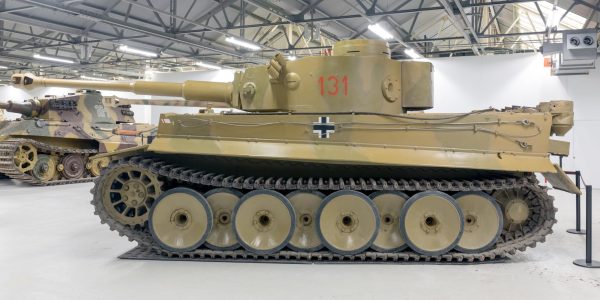
The biggest difference between the Tiger H1 and the Tiger E is the cupola (commander sight visible on top of the tank) size. The earlier version the Tiger H1 has a larger more profound cupola while the Tiger E has a smaller more protected cupola. The E also has a better engine, turret traverse, and slightly better armor.
The other thank visible in this image is called the Tiger 2 and that is the next tank review I’m doing.