


















Lady Jane Grey, also known as the “Nine Days Queen” was placed on the throne in 1553 after King Edward VI named her as his successor in an attempt to keep England Protestant. However, this caused an outrage from the public due to questions regarding legitimacy, religion, and public identity. And many believed that Edward’s half sister, Mary Tudor, had the stronger and more legitimate claim to the throne. So after only nine days Mary gathered support and claimed the crown for herself. Jane was later imprisoned in the Tower of London and executed at 16 years old in 1554.
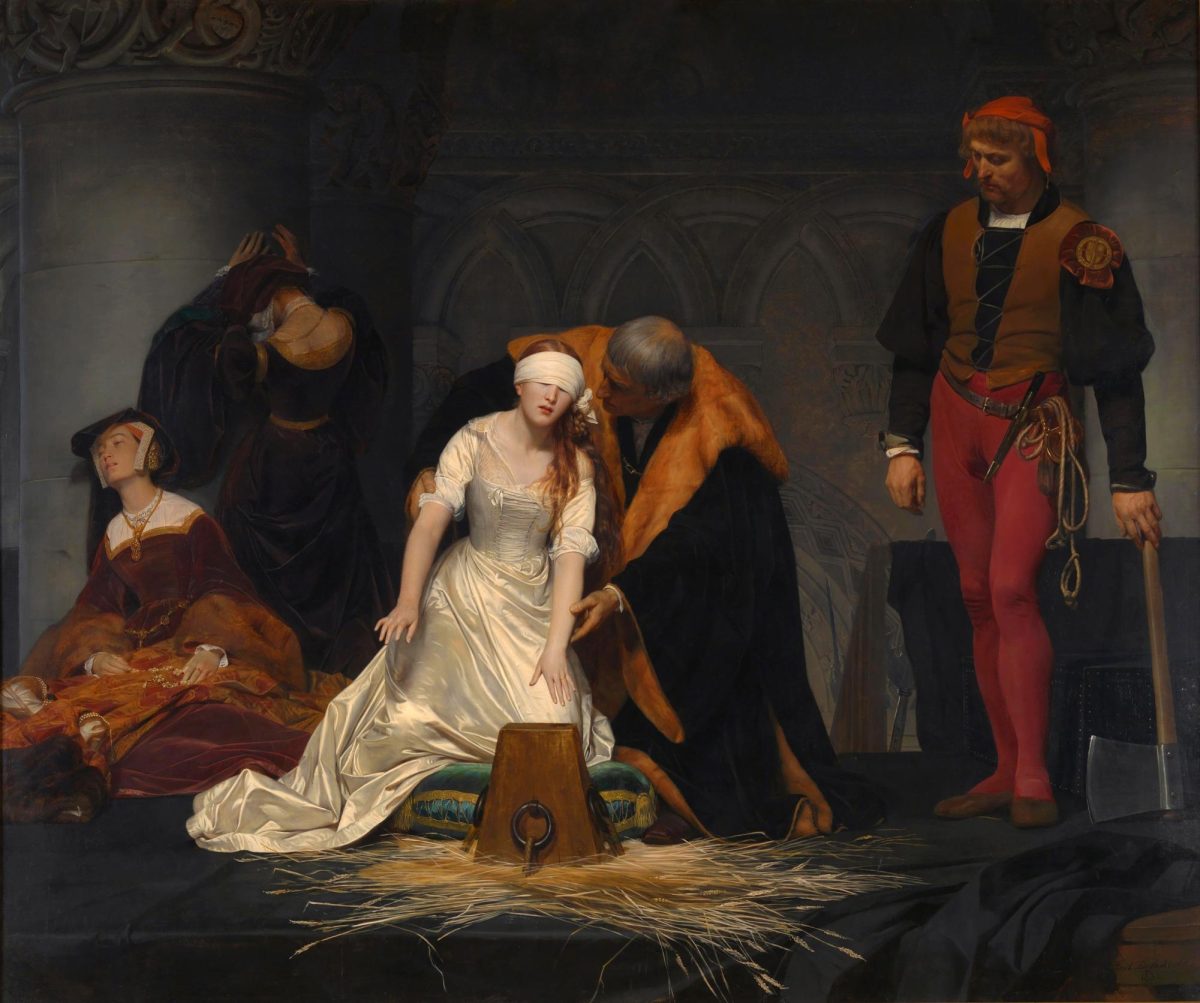
The Execution of Lady Jane Grey painted by Paul Delaroche illustrates the emotional intensity of this tragic moment. The young queen is seen blind folded and dressed in white, symbolizing her innocence. Her loved ones are seen turning their head out of utter horror or collapsing from shock. Blindfolded and unable to see, Jane reaches out helplessly in search of the execution block. Her hands are seen grasping empty air, emphasizing her vulnerability in the moment. Because she cannot find the block herself, she is forced to rely on the guidance of the enemy beside her while the executioner waits patiently in the corner. Historically, it is said that even in her final moments Jane remained composed, apologizing to the executioner after accidentally stepping on his foot. This small yet crucial detail further highlights her innocence.
Delaroche’s The Execution of Lady Jane Grey reflects the interconnected global issues of political power abuse and gender inequality. Jane’s brief reign and tragic death were the result of powerful men manipulating her to maintain control of the English throne. Although she was declared Queen, she never had real authority and was used as a political tool in a larger power struggle. In the painting, her blindfolded figure reaching helplessly for the execution block symbolizes not only her physical vulnerability, but also her lack of authority within a male dominated system. The executioner guiding her further emphasizes this power imbalance, as she if forced to rely on others even in her final moments. Through this portrayal, Delaroche highlights how political ambition and a patriarchal society often exploits women, reducing them to tools rather than granting them true control over their own futures.